clickspring
patreon
Rosin up your bow folks, it's time to have a look at the lathe that I think was very likely used to construct the Antikythera Mechanism - Do please enjoy!
Thank you all so much for your support this year, and I wish you the very best for 2024.
Cheers,
Chris.
ps Be sure to come and say hello on the Clickspring Discord, every Sunday at 2200UTC. Lots of makers, sharing a love for all things creative - https://discord.gg/KaG6bxQzZY
Direct links to the video -
Vimeo: https://vimeo.com/898845102/b2eae2fae4
Youtube: https://youtu.be/SVTcs3ziNJI
-------------- Video Notes: ---------------
References/Further Reading:
Posidonius - https://en.wikipedia.org/wiki/Posidonius
Geminus - https://en.wikipedia.org/wiki/Geminus
Hipparchus - https://en.wikipedia.org/wiki/Hipparchus
Vitruvius - https://www.chenarch.com/images/arch-texts/0000-Vitruvius-50BC-Ten-Books-of-Architecture.pdf
Cicero, DE NATVRA - https://web.archive.org/web/20070316053820/http://www.thelatinlibrary.com/cicero/nd2.shtml
Metal Working in the Ancient World (https://doi.org/10.2307/500498)- Author(s): Herbert Maryon – 1949
Herbert Maryon - https://en.wikipedia.org/wiki/Herbert_Maryon
Wright, M. T. 2011. “The Antikythera Mechanism: Reconstruction as a Medium for Research and Publication.”
"Clockwork Before The Clock" D Price Horological Journal vol.098 No.01 Jan 1956
Stone Vessel Making - http://www.oocities.org/unforbidden_geology/ancient_egyptian_stone_vase_making.html
The Woodturning Lathe: A Brief History - https://www.highlandwoodworking.com/woodnews/december_2005/employee_contribution.htm
The Ancient Craft of the Pole Lathe Woodturner. - https://www.academia.edu/7511378/The_Ancient_Craft_of_the_Pole_Lathe_Woodturner
Tomb of Petosiris: https://core.ac.uk/reader/80518060
Ancient greek furniture - https://www1.up.poznan.pl/furnituredesign/sites/default/files/u8/56-62_Ancient-greek-furniture_-source-of-inspiration-for-the-designers-and-manufacturers-of-modern-times.pdf
Woodturning with Moroccan bow lathe - https://youtu.be/RMQrz1gJy9M
Moroccan Bow Lathe - https://www.youtube.com/watch?v=wnv0DAR_gWA
https://2.bp.blogspot.com/-To97wy-WU-o/TpMEKgb-d-I/AAAAAAAAArU/Zfp6G-Kkhpg/s1600/Artisan+%25234.jpg

Re: Lathe , you mention the points being lightly sprung.. are they carburised as the other tools or would mild steel be sufficient? Is it 1/4 or 5/16 stock more or less?
Great to have you watching George, so pleased you're enjoying the videos :)
Chris what you do here is just wonderful. I’m a retired Methodist preacher. In the 1960’s I repaired clocks in a small shop as summer job from college. One New Testament text book had a picture of this “hunk” of metal found in the Med that looked like clock works to me. Then in the 1980’s that same photo of showed up in the nightly news. By now we know it was Antekythera. In undergraduate and Duke Divinity School we were lead to believe those people from ancient time, the Bible folks, were too ignorant and backward to be able to write or believe. On several occasions I’d ask if this was so, if these people were so backward, how do we have the pyramids and other wonderful artifacts: Dead silence. Your videos are wonderful. I don’t expect you to begin preaching, but putting your work out on YouTube and Vimeo will spread the wonder of ancient skills and human achievement. Thanks again and God bless!
There are no features in the wreckage that I would necessarily describe as 'drawn tubes', although there are several deep drilled holes and several 'collar' shapes, each of which can be accounted for with either the drill or bow lathe, or just simple crude forging. (there are tubes proposed as part of various hypothetical models, but of course no physical evidence of said tubes) Having said that, I recall seeing something recently in my reading regarding drawplates for both wire and tubing in the period. It doesn't relate to the AM, I think it was a jewellery thing? I'll ping it to you if I recall where I saw it... Either way, a drawplate isn't necessary to explain any extant or proposed feature of the AM - Cheers :)
My pleasure mate, so pleased you enjoyed it :)
Awesome, thank you mate!
Thank you mate!
And also with the drive cord around the actual work. Vibration is a function of speed, and bow/pole lathe work is so immediate you adjust your speed to avoid it almost without thinking. I've made a couple of pole lathes that are used only between centres (no drive dog), and you can make containers with precise fitted lids etc. and remove the work as often as you wish and it is still perfectly concentric Cheers :)
Chris, do we know if the AKM tubes have seams or not?
Also, a Draw Plate would make nested tubes quite quickly.
I noticed a bit of a catch 22. A long while ago when you made the pump drills, you used your modern lathe to finish turn and balance the flywheels, but in this case the creation of the lathe needs to come before the pump drill. I suppose it's not hard to imagine the flywheels being roughly balanced using files, then once the lathe has progressed enough, balancing them perfectly in order to improve the accuracy of drilled holes. I love how beautifully simplistic this lathe is and I think I need one, not because there's something I need to make on a lathe but because the lathe is something I need to make. I would love to see the progression from this primitive lathe to the South Bend I use to have and I might just explore this matter myself. Thanks for lighting the fires of inspiration.
Hi Chris, 4th time I have watched this video, Gob smacked, !!! shared this video with lots of my friends, :)
My god, this might just be the most awed I've been by one of your videos in a long time. Phenomenal work and research Chris!
That's exactly what I was wondering as well. Your explanation cleared it up nicely.
I'd like to know when Drawplates were invented, as this is what they excel at. It's a hard steel plate with a graduated series of holes in them, countersunk on the backside. The annealed stock has a taper filed on one end, is coated in either tallow or bee's wax, and it's fed through from the back into the first hole the stock can't quite fit. Then the taper is held in a strong pair of tongs and pulled through. The operation is repeated, hole by hole, with regular annealing, until final dimension is achieved, with a significant increase in length. Tubing is also made this way with a short strip of metal that is cut to a long point at one end for feeding and pulling, The end result is a perfect tube. I've started with a shortish brass strip around 5 - 7mm wide, and ended up with a tube around 1.5mm diam. and a number of times the original length.
All interesting thoughts mate, great to have you watching :)
If indeed more holding force were needed, I think the work piece holder you have created can yield some potential clues. Tying a leather strap between the two iron points could be sufficient or a more elaborate method might use the same pinching as your holder does.
Thank you mate :)
Cheers mark, very pleased you enjoyed it :)
Is there any tool marks remaining on any fragments that might imdicate the tool forms used to create them ? I am also wondering if same shafts could be created by bringing a small bar up to temperature and then pulling on the ends like taffy. This comes to my mind as a way to get from a flat to a reasonable round thin rod. If done vertically, the bar should cool reasonably straight and might have a pretty decent surface finish. You might get a meter or more of rod out of a single operation.
first they would transmit more power and speed into the work since the throw is much longer than the hand bow. Secondly and more importantly they have better ergonomics keeping both hands free for holding the tools and using the larger leg muscle groups for more power, momentum, and less fatigue during use. Any society that could built a wooden bow would easily have all these principles figure out.
That lathe reminded me very much of the spring pole lathes I have seen and which are described in some of your references. I think one of those would be very likely available in your time frame and have two distinct advantages that I can see.
Consider my mind blown, that is amazing, video quality and your craftsmanship are just amazing!
I really appreciate the clarity and rich storytelling that you've woven into this episode. Just amazing.
Great question - No fixing is required, simply jamming a roughly forged square(ish) shape into an undersized hole does the trick. The twist is minimal, gently 'working in' the wood enough to permit tight, limited rotational movement in one direction. The light spring force (when the workpiece is loaded) clicks & holds the prong in place, also making a lightly 'worked in' position. Whilst in operation, no forces act to 'break open' the tool toward the opening direction. Btw, I did not expect this; it was a pleasant emergent property that I noticed whilst making the tool - Cheers :)
Cheers James!
Thank you mate :)
Work continues on all fronts - Cheers :)
Yes, Cheers :)
So pleased you enjoyed it mate :)
Would certainly have been an interesting apprenticeship!
So pleased mate :)
Thank you both!!
Yes, in fact its in the reference list above, terrific video - Cheers :)
Thank you Andre :)
Cheers mate :)
Wonderful as always - I'm curious about the fixturing of the lathe end trammels (or whatever you call them). Given that you have enough tool pressure to move the whole work piece and the lathe points, how have you fixed those points so they both rotate for inserting the work, and do NOT just rotate out of the way during turning, losing grip on the workpiece? Or is the taper plus the spring force actually sufficient to keep recentering itself in the end countersinks?
Sorry Chris (I blame Fatigue after New Years late to bed) I missed the crucial word "PLANS" in your question. Oops. Please disregard my 'replies'..... :/
OK, After spending 1/2 hour searching in vain on the Patreon site, typing in search phrases, and scrolling through, literally, hundreds of posts on the Clickspring channel, often unrelated, I went over to Chris's YouTube Channel and in two minutes had found it. I hate Patreon's new 'look'. Unless I'm missing something, it's really awkward to navigate and find things. This is part one of the depthing tool build. It's a 3 parter. Enjoy. https://youtu.be/q6xovvpuMQo?si=Xdf4QX7q_Np61AOa
Chris made a version of the depthing tool, I think (will check) during his pendulum clock build. One moment please...
All through many of the earlier Antikythera series I've asked, wow wouldn't a lathe be a great tool to use here! You've now answered that question and I have few doubts that they wouldn't have had such tools. The people of those days were some great engineers. Thank you Chris for traveling this path!
Yes with drive dogs. My interest was because this is not between centers in the same sense as it will be much more springy and prone to vibration.
Turning between centres, like this, is the way to do the most precise turning. You can take the work out, check/measure etc., and put it back in the lathe and it will be just as concentric as before :)
That is phenomenal… this series should be in a museum with the finished replica one day…. On another note, I now need a depthing tool, do you have plans for the one you made??
No worries :) With the dog drive pulley, you could set up a piece of timber, wrap the bow cord around that, and widen the groove in the pulley. Keep the edges of the wide groove angled as you have with your 'V' groove; will help with stopping the cord from climbing out in use.
Years ago I saw a video where Adam Savage referred to the lathe as the only tool that can build itself and wondered why that was. After watching this video I understand that more. Great work as always Chris.
Jesus, those are better results I get with my optimum lathe 🤦♂️. Just wondering how things are going behind the scenes and if you’ve got plans for more regular content in 2024?
Chris, can we expect an Antikythera mechanism (itself) video in 2024? It's been a long time!
Absolutely an 11! Would love to know also if he used stock vid, photos or animation to get that with a green screen. Other worldly and simultaneously real world...worth an Emmy, IMHO!
I must say, the end, with rendered ancient backgroung, gave me warm fuzzies. I hope this would be a new series - a lathe to made a better lathe, which then will make even better lathe, till your reach 19th century technology.
I can't help but imagine that it would the the apprentice working the bow half the time. "Now get a feel for how it turns while I work this end. Watch me carefully."
Made my year! Awesome
Blimey, Chris! In the depths of an ambitious project like this, you also turn your already fantastic videography up to 11. Are you even human?! 😅 Would love to see some BTS bits about your processes for those great shots at the end. Those kinds of ‘historical’ shots should help the wider audience appreciate the historicity of this project. Either way, as always, fantastic work! You’ve outdone yourself, mate (which is no small feat, let’s face it). I hope you and yours have had a wonderful Christmas and have a very happy new year.
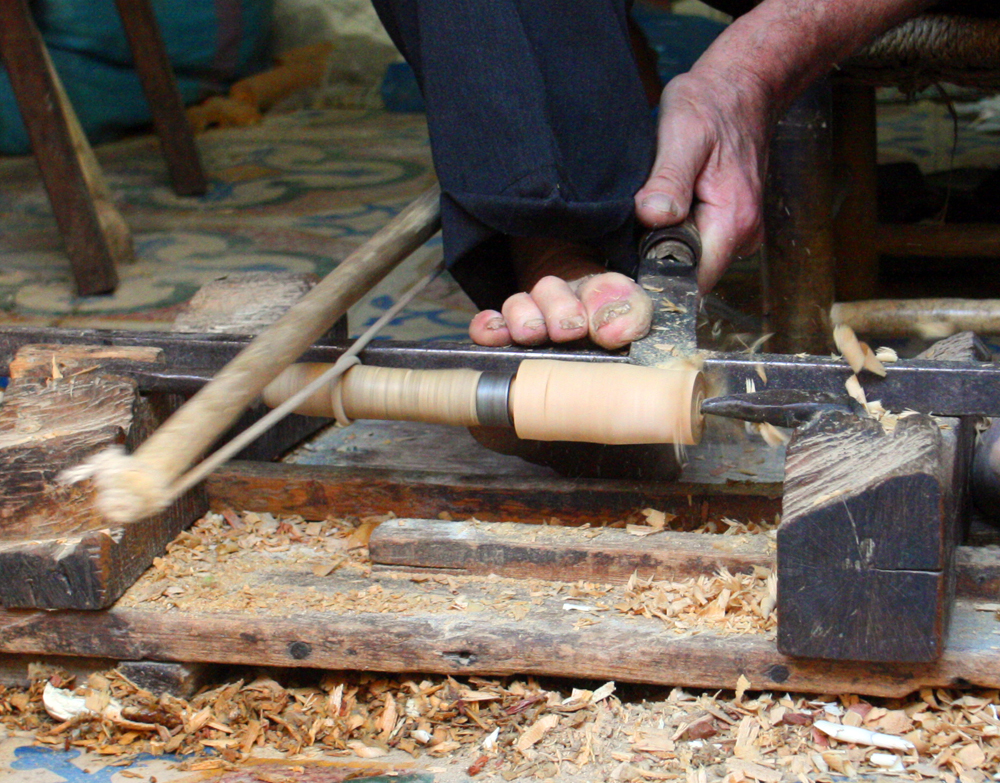
Have you see this video? https://youtu.be/wnv0DAR_gWA It shows a Moroccan using a bow lathe, and to make up for the fact that one hand is working the bow, he uses a foot to help control the chisel. With impressive results.
Mind blown again ,,,,,,great work Chris.
Machinist turned historian - great stuff!
Very nice. Would be interesting to see a test piece on a CMM or similar to compare the concentricity possible using this lathe.
Thank you Matthew - I'd be happy to let them go at the end of the project, would be nice for it all to go somewhere its going to do some good - Cheers :)
Thank you mate :)
Fantastic work Chris, its really interesting to see how the tools of the time might have worked. Your commitment to the history of the antikythera mechanism is really admirable. Keep up the good work! I wonder if you've considered reaching out to a local museum? Although replicas I'm sure tools of this type would make a really interesting exhibit
Again, blown away. Top notch content, presentation and production quality. You are unbelievable! Thanks for your work! Happy to be able to witness your journey.
I would expect so, the cutters handle mild steel well. The Antikythera bronze is low tin, behaves much like a modern brass in the cut, will cover the metallurgy in a future video - Cheers :)
You turn some brass here. How is bronze for turning? Do the alloys that are suitable for being worked in a lathe have stringent tolerances on their composition or are most tin bronzes good?
Thank you mate, good tips, will widen the groove! Cheers :)
Thank you mate, same to you :)
Some light reading for the New year! Cheers mate :)
Thank you Scott :)
Thank you mate - yes, a key tool for some of the upcoming bits and pieces - Cheers :)
Love the little 'Turns' style lathe Chris! Spectacular. The 'Pole' and 'Bow' style lathes are my favourite; fantastic speed and tool control, and the benefits that come with turning between centres. Yours must be getting close to the absolute basics. I was surprised with your 'twist and fit' method of mounting the work between centres, thinking the work might piff out while being driven, but your vertical action, of course, is at right angles to the 'twist', so doesn't seem to be a problem :) A couple of hints from my experience: make the bow string groove like a short cotton reel so the string can wind back and forth, side to side, instead of rubbing past itself in use. And with your left handed driving, rotate the bow counter clockwise when setting the line around the drive pulley so the line doesn't cross itself and rub. These two modifications should greatly increase the life of the line, and give a much smoother sound and feel to the bowing. Makes me want to go out and make one !!!! My forked branch pole lathe, after a number of years, expired, and I currently have no space for setting up my large (3' bed) collapsible pole lathe, but your little (almost pocket sized) bow lathe is *sooo* cute and basic. Now, off to have a rest before going to the New Years party, later, next door :) Was about to when I saw this video had dropped :D
Ending of the year with a bang, I see. I remember how back in the skeleton clock project days you expressed your love for free hand turning, I hope you enjoyed working on this ancient lathe as much as you do on modern ones. Also do not think we overlooked how your videos become more and more cinematic by each upload. I hope this upcoming year brings great fortune and good health to you and your loved ones.
That's the beauty of turning 'between centres'. No matter how often the work is removed, checked, etc., when replaced in the lathe ( or 'Turns' in watchmaker speak for this type of lathe) it will run true :)
Wow, what a bibliography!
Nice work, Chris.
Just watched it. Excellent. :) Presumably this is the tech required for making, or at least fine tuning, the nested tubes. When you first switched ends on the test wood cylinder, I was watching how well it retained its concentricity on the first turned end, and it was smoooooth as. The only lateral motion I could see was due to the whole lathe assembly moving as one. :)
Cheers Jonathan :)
Me Too! So pleased to have finally got to it :)
Yep, this is the one I have been looking forward to. :)
Spectacular! Thanks for the video.
Been waiting for years for this video! 😀😀