Sabine
patreon
[This is a transcript with references.]
In 2007, the mayor of the small German town Staufen decided to do his part for the environment. He approved a drilling project to heat the old city hall with hot water from underground. The drilling began in early September and went 140 meters deep. About two weeks later the first walls began to crack. The cracks became deeper. Buildings were evacuated. Then they were torn down. Then, the lawsuits began. Oh, and they elected a new mayor.
Geothermal heat could solve our energy problems, if we just dig deep enough. But how much can geothermal energy realistically help with reaching net zero? What new technologies are being developed? And what the hell happened in Staufen? That’s what we’ll talk about today.
All planets in the solar system, including Pluto, formed from the same ball of hot plasma as the sun. The major difference between our Sun and the planets is that it’s larger. And because the Sun is larger, its gravitational pressure can sustain nuclear fusion. Smaller clumps of matter, like our Earth, can’t do that. So, they cool, and before you know you have people driving around in pick-up trucks with bumper stickers complaining about the government.
But it takes a long time for a planet to cool. Therefore, Earth is really still a ball of this hot plasma, just that it now has a crust on the outside where it’s already cooled. But when you dig, it gets warmer. And the deeper down you go, the warmer it gets.
Scientists believe that the temperature at the Earth’s core doesn’t just come from this initial heat of the plasma, but comes partly from radioactive decay. But no one knows exactly, because no one’s been there, probably because the centre of earth is about as uncool as is gets.
The temperature at the core of earth is an estimated five to seven thousand degrees Celsius, that’s about the same as the surface of the sun and my office in the summer. But we don’t need thousands of degrees. A few hundred degrees Celsius are sufficient to boil water and drive turbines with it. Such temperatures can be found in a few kilometres’ depth in most places on Earth.
Just how deep you have to dig for that depends strongly on the location. In some places one doesn’t have to dig at all because steaming hot water bubbles out of the ground. On the Azores, they make stew by lowering it down into a hole and cooking directly with geothermal heat. In Reykjavik they heat the sidewalks in the winter with geothermal heat. But in most places it isn’t that easy.
Geoscientists estimate that the total energy reserves in the upper 10 kilometres of Earth’s crust are about 10 to the 27 Joule. The total global energy consumption per year is at present about 5 times 10 to the 20 Joule. This means if energy demand remained stable, geothermal energy would last several hundred million years.
You may suspect that it isn’t terribly realistic that we exploit all this energy and you’d be right. But a somewhat more realistic evaluation comes from the US Department of Energy. They refer to geothermal energy as “America’s untapped energy giant” and estimate that the generation of electric energy from geothermal sources in US has the potential to increase from presently about 3 point five Gigawatts to more than sixty gigawatts by 2050. Then it would provide 8 point 5 percent of the total US electricity which is a refreshing change from securing energy supply by invading other countries.
And this is only for using geothermal energy for electricity generation. ‘Estimates are even more impressive if you include direct use, that is heating with geothermal heat. Researchers from the National Renewable Energy Laboratory claim that every house in the US could be heated from geothermal sources for millennia.
This sounds good but in reality, geothermal energy presently plays a small role in most places on Earth. In 2020, the total global power capacity of geothermal was about 15 GigaWatts. This is about 1 percent of the worldwide installed solar capacity, or 0.2 percent of the total.
The world leader in *total geothermal energy production is currently the US, but that’s mostly because it’s a big country. If you look at the numbers per capita, the world leader is, no surprises, Iceland. In Iceland, geothermal sources deliver a whopping 66 percent of the primary energy. That’s more than 6 MegaWatts per person and far ahead of the next big geothermal nation that is Sweden with less than a tenth of that.
Here you see an illustration of a geothermal power plant in Iceland, which is pretty straight forward. Pump down cold water, get hot steam back up, cool the steam and extract energy from it, repeat. This is the Krafla power plant. And these are some images from Iceland just for relaxation.
Carbon-dioxide emissions for most geothermal power plants are low, according to the IPCC comparable to those of solar power, but in contrast to solar power, geothermal sources deliver 24/7, 365 days a year. And while some plants release sulphur dioxide from underground, it’s fairly small amounts and it can be filtered out. Geothermal energy isn’t expensive either. As you see in this figure levelized cost of electricity from geothermal power plants is currently comparable to that from solar and wind.
This might make you think geothermal energy would be expanding rapidly but not so. The global trend in the past five years doesn’t differ from the trend in the previous decades, and it’s pretty much linear. Though in some countries the expansion of geothermal has picked up, that’s Turkey, Indonesia, Kenya and the USA.
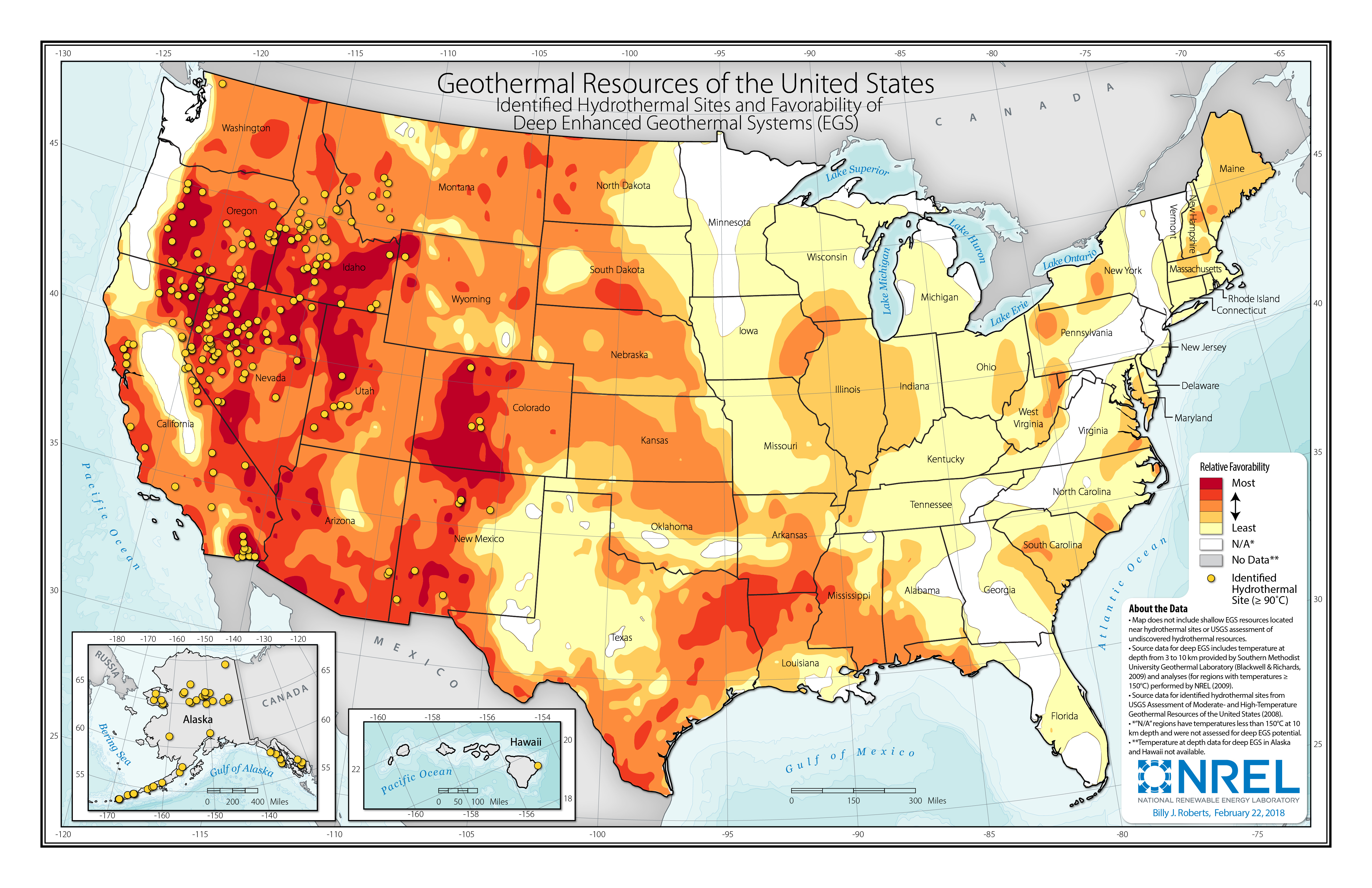
The issue with geothermal energy is that while it works very well in *some places, these places are rare. This figure shows the geothermal resources of the US. As you can see there’s much more potential on the West Coast. And America is a geothermically lucky part of the world. This figure shows the global potential for geothermal energy. The redder, the better and I swear this is not a political statement.
What this means is that in many places you have to dig deep, not just into the ground but also into wallets. Indeed, if you look at this figure again, you’ll see that while the costs for solar and wind have been dropping, the costs for geothermal and hydropower have been rising, and basically for the same reason: The best places have been taken long ago and now the returns are diminishing.
Costs of a geothermal plant are heavily weighted toward early expenses, while the operating costs are comparable to those of solar and wind. Geothermal wells are often more than twice as deep as oil wells, and the drilling accounts for more than 50 percent of the total costs. For example, in the US, drilling a 4 kilometer hole costs about 5 million dollars. For 10 kilometres, the drilling cost skyrockets to 20 million dollars per hole.
By the way, the deepest hole ever drilled on Earth is the Kola Superdeep Borehole in Russia near the border with Norway. It reached 12,262 metres in 1989. According to an urban legend, the Russians working on the project announced they’d drilled into hell and wanted nothing more to do with it. Whatever the reason, they put a lid on the thing didn’t reopen it and no one’s ever broken the Russian record.
So what can we do to get more geothermal energy into the grid? Well, for one we can try to make it more affordable.
One reason the drilling is so expensive is somewhat surprisingly not actually the equipment, it’s time. According to a 2015 paper by a group of American researchers, what makes the drilling so expensive is that when things don’t go as planned – because something breaks, or something leaks, or the ground isn’t as expected – the entire crew must sit around and wait on site. The costs for this are tens of thousands of dollars a day, whether those people work or not.
This means planning plays a big factor for bringing down the costs. The oil and gas industry has a big advantage in that because they’ve built expertise going back more than a century. But geothermal is also expensive because things break and must be replaced like drills and stuff. This means there are three major ways to make geothermal energy work better: better preparation and management, better methods to find and exploit sites, and better ways to drill.
How do you prepare people for drilling? Well, of course, by teaching them physics. Yes, physics. In 2020, two researchers from Texas developed a training program for managers of drilling operations, teaching them things about rocks and cracks and stuff. This cut down the drilling time into half and significantly reduced the cost. Quite amazing what a little physics can do. But then, I may be biased.
Another way of preparing is to do more studies of the ground and what the drilling does to it. Many projects on this are currently underway, for example the GeoVision project in the US, and the European Union has a similar project called GEOENVI.
But leaving aside issues with management and training, there are physical reasons why geothermal drilling is more challenging than drilling for oil. You have to dig deeper and the rocks get hot, really hot.
A particularly relevant factor for efficiency of a geothermal power plant is an obscure physical quantity called the specific enthalpy of water. Enthalpy measures how much energy a substance can carry. It’s a function of environmental conditions like temperature and pressure.
The thing is now that the enthalpy of water at around 200 times atmospheric pressure increases rather suddenly at 374 degrees Celsius. Above that temperature, the water is called “supercritical”. This doesn’t mean it’ll start commenting on your hairstyle, it means it’s neither a liquid nor a gas but both at the same time. Supercritical water can carry several times more energy per mass, and the conversion to electric energy becomes more efficient. Taken together this increases the energy output by up to an order of magnitude, which is really impressive.
Drilling companies call their holes wells. More than 25 geothermal wells have encountered temperatures above 374 degrees, but so far none of them have been used for energy extraction for an extended amount of time.
The issue is, it’s difficult. In the 1970s, the Italians drilled a hole in Tuscany that would have been suitable for a supercritical power plant. But these wells aren’t only hot, the hot rocks also contain a lot of unpleasant chemicals. Those make the water that’s used for drilling highly acidic, which wrecks the equipment. Even if you don’t use water, you have acidic gases bubbling up. In this case the drill pipe corroded and broke and the well had to be abandoned soon after drilling.
The Italians tried it again with a second hole. It blew up. In 1981 in the United States tried to tap onto a supercritical reservoir but drilled into high pressure steam that caused the casing to collapse. This well, too, was abandoned.
1988 in Iceland they just about prevented the same thing from happening by quickly dumping a lot of gravel down the hole. In 2003 they tried again near Reykjavik, but the hole became blocked for unknown reasons and was abandoned.
Then there was the Iceland Deep Drilling Project. The first plan, in 2009, was to drill to 4 point 5 kilometers depth. However, just beyond 2 kilometers they drilled into magma that plugged the lowest 20 meters of the hole. Gases began bubbling up. The surface equipment experienced significant corrosion which eventually led to a failure of the main valve. The well was shut down.
They drilled a second hole in 2014 which encountered the same problem: acidic gases that wrecked the equipment. They did however test this well for more than 1 year and found to be capable of producing more than 36 MW. The third deep well of the Iceland Deep Drilling Project is planned for the next few years.
As you see, geothermal isn’t for the faint-hearted.
Next thing you can do is help nature along by creating geothermal sites rather than using existing ones. These are called “Enhanced Geothermal Systems”. The American company AltaRock Energy for example, uses a beam of microwaves to drill small holes, crack rocks, and then clog the cracks with a biodegradable substance. This prevents the water from seeping into the rocks so they can drill even deeper and create and extended network of cracks through which water can then be circulated. The company says it’s a cost effective and efficient way to get thermal energy out of many rocks that otherwise wouldn’t lend themselves to water circulation. They have a test-site in Newberry, Oregon.
The UK-based company, HydroVolve, launched last year what they call GeoVolve HAMMER. Instead of just rotating the drill, they also hammer with it, which is called percussive drilling. Their device is plug and play and adapts to the environment. They claim that this is less damaging to the drill, can speed up drilling by up to 10 times and cut costs by half.
Researcher from France and the UK are developing another new drilling technique that adds a high pressure water jet. The idea is to use the water to cut the rock into particular shapes so it can then be more easily broken by fluid-powered percussive hammers. The researchers claim that this technique will drill rocks more than twice as fast as current technologies and that it would reduce costs by up to 65 percent. S far they only have computer simulations and lab tests but they expect to have a real-world prototype by 2024.
Another method presented by Japanese researchers uses water to give the rocks thermal shocks by sudden heating and cooling, also known as “summer” in the UK. This cracks the rocks a bit, so they are then easier to drill. They are currently making test drills, down to some dozen meters and are filing patents.
A company called Petra uses a torch of gas at super high temperature, a plasma really, to drill rock thermically. They have a prototype and are currently testing it.
And researchers from MIT want to combine a traditional rotary drilling with millimetre-wave laser. They claim that this way they’ll be able to drill 20 km deep in just 100 days of drilling. They want to start drilling in 2024 and maybe then we’re figure out whether the Russians really found hell down there.
Last year, the US Department of Energy announced up to 20 million dollars in funding to lower the cost of developing geothermal energy so we’ll probably hear a lot more about drills in the near future.
So what happened in that little city Staufen? Germany has a lot of sediment layers and predicting just what you’ll find if you drill into the ground is extremely difficult. In this case what happened is the following.
The drill went through a Keuper layer and into a reservoir that contained warm water under high pressure. The lower part of the Keuper layer has a fairly high content of clay and shale. This has blocked off the water from the upper keuper layer for the past 200 million years or so. But now they drilled through it. The pressure drove the water up and it leaked into the upper part of the Keuper layer.
That keuper layer is mostly calcium sulphate. It reacts chemically with water to form a type of gypsum. Trouble is, the gypsum has a higher volume. So, this entire layer, which is more than a hundred meters thick, started to expand. This raised parts of the inner city, in some places more than half a meter. But it didn’t raise the ground evenly, so the buildings began to crack. The same thing happened in several other cities in Germany.
If that sounds scary, it’s because it is. But the problem is rather specific. This Keuper layer itself only exists in some parts of Europe. And now that the problem is on the radar, new drilling projects are watching out for it.
But there are more general problems with drilling projects. Creating cracks in rocks for extended geothermal systems is quite similar to fracking and it increases the risk of small earthquakes and explosions.
For example, last year operations at a geothermal project in Cornwall were temporarily stopped after seismic activity was detected. In April 2020, a well blowout was reported in Indonesia, and similar accidents have happened in Australia, Chile and Japan. In 2021, a high-pressure burst of gas at a well from a geothermal project in Sumatra killed five, and injured 24.
And the drilling might not be the only problem. Researchers from Germany and Spain reported in 2019 that for supercritical reservoirs, earthquakes are also induced by the cooling of the rocks which comes from operation of the power plant. After all, its very purpose is to extract the heat. They use a computer simulation which shows that the rate of induced seismicity at the fault increases four orders of magnitude after 7 to 10 years of water circulation. The authors claim that this result suggests that the lifetime of supercritical geothermal projects is limited by cooling-induced earthquakes.
One final thing to notice is that geothermal plants do emit greenhouse gases. That’s because the fluid which they circulate carries carbon dioxide and methane and often a number of other nasty chemicals out of the ground. Just exactly how much depends on the ground, so it can be difficult to predict. Looking at a global average value is misleading for geothermal because the variation is so large.
This figure for example shows the carbon dioxide emissions from several geothermal plants in Iceland. For reference, the average lifecycle emissions of a natural gas power plant would be at about 500 grams Carbon dioxide per kilowatt hour and those of solar at around forty. There are some geothermal plants in Turkey and Italy that actually emit *more* carbon dioxide than natural gas power plants.
So what do we learn from this? What I take away from this is that geothermal energy is at the moment underexplored and underfunded. There is a lot of potential in it that can be tapped onto with more research and better technology. It also seems to me however, that these drilling operations are and will remain risky, and for that reason also expensive. Like many other things we’ve been talking about, it isn’t going to be a panacea for climate change.

My feeling is that it isn't a waste of money, but a lack of leadership at the federal level, regardless of which country we're talking about. See my post about small-scale geothermal using heat pumps. That is something that can be used in individual homes and city buildings, but the upfront cost is greater, thus requiring leadership to fund its development and implementation as the long term costs are far less. The US tends to think only 10 minutes into the future and relies on 'the market', which doesn't work for environmental, social scale problems.
The one mode of geothermal that you didn't cover was that used with a heat pump (https://www.energy.gov/energysaver/geothermal-heat-pumps). I am a city of Elgin Illinois Sustainability Commissioner and had the experience of hearing a presentation of such a system installed in a church just outside Chicago. The presenter is a HVAC professional and the overall energy use reduction was phenomenal, especially since the structure was made more efficient. This level of geothermal can be used everywhere as it uses the mass of the earth as the exchange medium rather than steam generating heat. The problem is in the cost of the drilling. New construction can use any of the types shown in that link, while existing structures would tend toward either the vertical closed-loop or the open-loop systems. We would like to make this affordable somehow to reduce the energy Elgin uses as a city.
Thanks for sharing your thoughts on this Tracey. I like how you said it, “It’s in our nature to try to intuitively interpret constants of nature.”
I wonder if the industry is just going through difficulties in establishing the infrastructure or if it's all a gross waste of money, effort and equipment.
Yes, I have thoughts... First, I've always been bothered by the accelerating expansion of the universe. I can't help but feel that there is a big interpretation error, something like Subir Sarkar and his group point out with certain systematic uncertainties that have not been properly accounted for. This is my own personal hangup, so let's concede that the expansion of the universe really is accelerating. Some background for others who might be listening in, the cosmological constant is a fundamental constant of nature due to the geometry of spacetime. Just like c or epsilon_nought, there doesn't need to be an explanation for it, this is just how our universe works. We could stop right here -- no further explanation needed, but that would be unsatisfying. It is in our nature to try to intuitively interpret constants of nature. For example, the permittivity of free space, epsilon_nought, can be thought of as the capacitance of a vacuum or how nature permits an electric field to form around charges. When it comes to the cosmological constant, our intuition is that it acts as a pressure or energy that not only opposes the gravitational attraction between things on large scales, but that also results in an acceleration of the expansion. This, of course, could be a completely wrong interpretation. But theorists press on -- what could cause this pressure and what could cause a change in this pressure over time (the Hubble tension problem)? /end{background} This black hole group, with a whopping sample of 5 high redshift black holes and 1 local black hole, seems to have confirmed that their model can reproduce a time-varying pressure. I have no doubt that these researchers dotted their i's and crossed their t's and their model is certainly plausible, but they may also have solved a problem that doesn't exist. I do especially like that they put forward some things astronomers can look for to confirm or deny their hypothesis. In particular, I had thought that MACHO's were completely dead due to all of the null results from microlensing experiments. However, this group posits that MACHO's could still exist below our current detection limits. A renewed microlensing search with newer, better detectors on bigger, better telescopes might find something useful, if these guys really are right.
Oops, once again, messed up the reply placement, see 👇
Hi Tracey, I sure am glad you didn’t hold back. Interesting story and now that I know, I’ll join you on that hill. I first heard a pre-school girl tell the audience Pluto was a planetoid. She said it with such glee, I knew it had to be true! She has informed her father of many other things since and there is no doubt more to come. Question for you, have you seen this paper claiming that black hole interiors are vacuum energy and taken as background can account for the value of the cosmological constant? They looked at SBMH masses in elliptical galaxies at different Z and conclude the masses are inconsistent with mere accretion of baryonic matter. At least that’s my understanding: https://iopscience.iop.org/article/10.3847/2041-8213/acb704
It's always nice to have my own personal ignorance confronted and corrected. I had not appreciated the technical issues, the cost, or the politics surrounding why geothermal just hasn't taken off as a reliable energy source. Now, about Pluto... I was at the 2006 International Astronomical Union meeting in Prague when the official vote was cast to downgrade Pluto and it was the right thing to do. There, I've said it and I will die defending this hill. We were following the precedent set when all of the big asteroids in the Main Asteroid Belt (Ceres, Pallas, Vesta, etc) were downgraded in the late 1800s -- yes, there were officially something like 40 planets or so at one time before astronomers realized that most of them defined an asteroid belt between Mars and Jupiter. Oh, and it's cruel to make 4th graders memorize 40-some planets. When Mike Brown discovered Eris, which was originally thought to be larger than Pluto, he thought he would go down in history as the discoverer of the 10th planet, but that was not meant to be. Now we know that Pluto, Eris, and a whole lot of other icy bodies form a 2nd asteroid belt that we now call the Kuiper Belt. And another thing, Pluto was not downgraded because it didn't fit the definition of a planet. Astronomers had never had a formal definition of the word planet prior to 2006 -- the word planet just comes from the Roman word for "wanderer". Pluto was first downgraded _and then_ a definition of planet was devised to keep the big 8 and specifically exclude anything in an asteroid belt. But at the same time, a new class of object was created to hold Pluto, Eris, and a few other asteroids as Dwarf Planets and good old Ceres, remember him from the Main Asteroid Belt, was upgraded into this new class. Yes, you can certainly say dwarf planets are still planets, but you're just living in a delusion. I know, off topic and TMI to rebut a joke, but I couldn't help myself :-).
Good one. Thank you Sabine and team.
Maybe there are better solutions, than drilling into the ground?
25 years ago a Brit was fed up. He spent $30k for what I think was Heat Pump Earth Loop not buried that deep. Evanston IL.
Not true. Pluto is not a planet, it’s a planetoid, whatever that means 😂. Everything else is spot on. The only reason we chalked up a small return on the geothermal restructuring was a government tax incentive program that provided a cash rebate for the cost renewable energy projects regardless of ownership continuity. In other words, taking over as a new owner in Chapter 11 did not disallow the tax benefit. The initial owners who spent most of the money got nothing. Aside from drilling costs, which as you say can become astronomical, the other costs that are often ignored in planning are the legal fees these projects consume. Waging battles with various creditor groups, equipment vendors, E&C contractors and local farms consumes astronomical billable hours.